
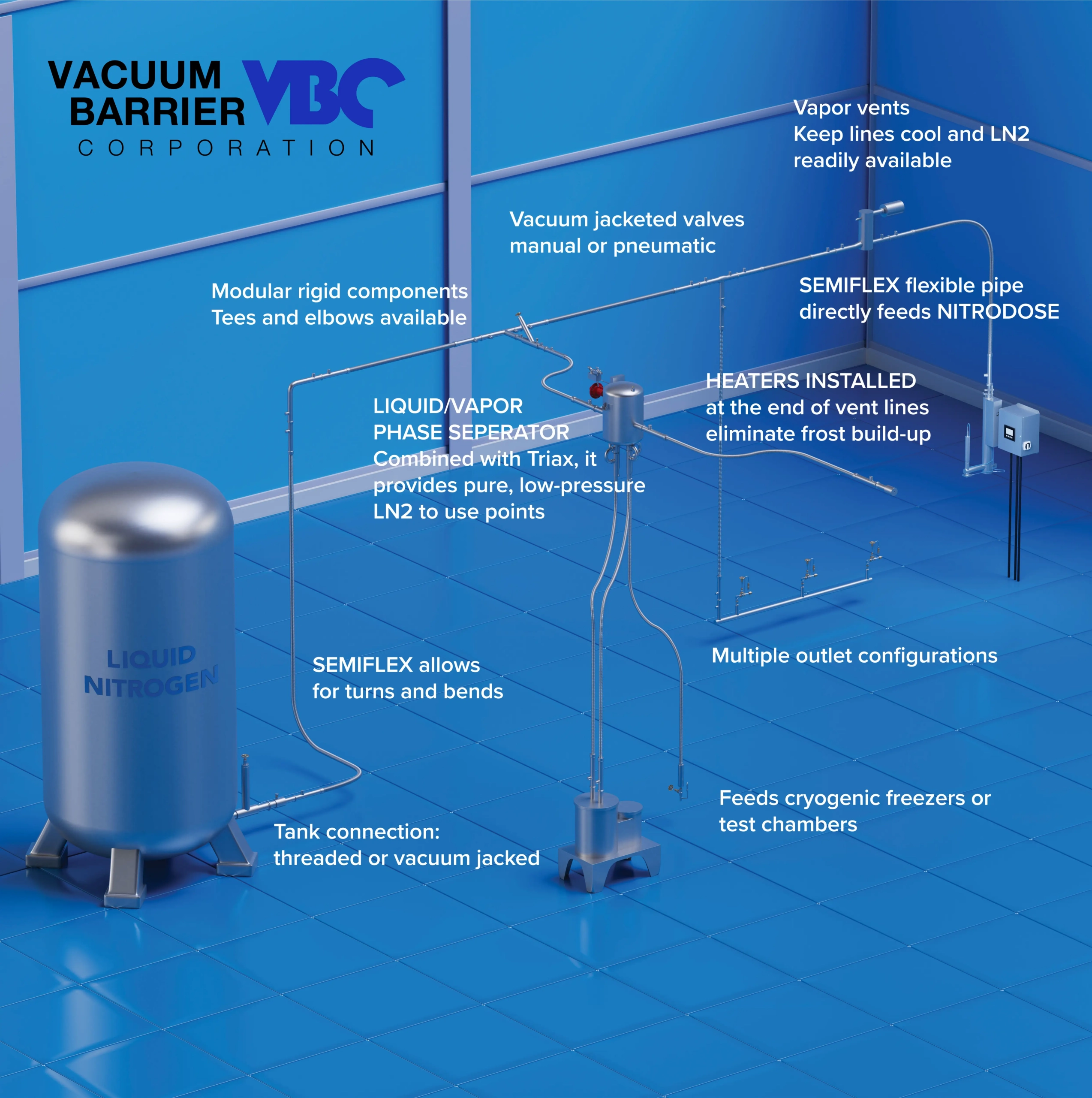
When designing a liquid nitrogen (LN₂) distribution system, it’s easy to focus on the equipment that uses the nitrogen. Whether it’s a cryogenic freezer, semiconductor testing chamber, or liquid nitrogen dosing system, the end application typically receives the most attention. But what happens between the bulk storage tank and that equipment is just as important.
A properly designed cryogenic piping system must do more than transport liquid nitrogen from one location to another. It needs to minimize heat gain, manage vapor, accommodate the facility’s layout, and deliver LN₂ in the condition required by each application.
Overlooking these considerations early in the design process can lead to unnecessary nitrogen consumption, inconsistent liquid delivery, and operational challenges that become increasingly difficult to address once the system is installed.
Start with the Entire Distribution System
One of the most important considerations in cryogenic plumbing design is understanding how liquid nitrogen will move throughout the facility.
A typical system begins with a bulk LN₂ storage tank and extends through a network of piping, valves, connections, and other components before reaching the equipment. The design becomes more complex when multiple machines or production areas require liquid nitrogen. Each additional use point introduces considerations related to piping distance, flow requirements, pressure, and heat gain.
Before selecting piping components, engineers should evaluate the facility layout, expected nitrogen consumption, the number and location of use points, and whether the system may need to accommodate future expansion. Planning around the complete distribution network helps ensure the system can meet current requirements without creating unnecessary limitations as operations grow.
Why Vacuum-Jacketed Piping Matters
Liquid nitrogen boils at approximately -196°C (-321°F) at atmospheric pressure. Maintaining it in liquid form during transfer requires effective thermal insulation.
As heat enters a cryogenic piping system, some of the liquid nitrogen vaporizes. This creates additional gas that must be managed and reduces the amount of liquid available downstream. Vacuum-jacketed piping addresses this challenge by surrounding the inner liquid-carrying pipe with an evacuated insulating space. This greatly reduces heat transfer from the surrounding environment.
VBC’s SEMIFLEX® vacuum-jacketed piping is designed to limit heat gain during LN₂ transfer, helping maintain efficient delivery from bulk storage to individual use points. Vacuum jacketing is especially important in facilities with long piping runs, multiple connections, or equipment requiring a consistent supply of liquid nitrogen. The objective isn’t simply to prevent the outside of the pipe from becoming cold. It’s to preserve the condition of the liquid nitrogen traveling inside it.
Designing Around the Facility Layout
Very few industrial facilities offer a straight, unobstructed path between the bulk tank and the equipment. Piping systems often need to navigate walls, structural supports, existing utilities, production equipment, and other physical obstacles. This makes flexibility an important design consideration.
SEMIFLEX piping allows for turns and bends within a cryogenic distribution network, while modular rigid components, including tees and elbows, provide additional options for routing and branching. Together, these components help engineers develop piping configurations suited to the facility rather than forcing the facility layout to accommodate a rigid piping arrangement.
Modular design also provides advantages when production equipment is relocated, or new use points are added. However, routing decisions should consider more than physical clearance. Engineers must also account for pressure drop, pipe supports, thermal contraction, and access for inspection and maintenance. A shorter route is not necessarily the best route if it creates unnecessary complexity or makes critical components difficult to access.
Choosing the Right Valves and Connections
Valves and connections are another important part of cryogenic piping design. They provide the ability to isolate sections of piping, control flow, and connect equipment to the distribution system. However, these components can also become sources of heat gain when they are not properly designed for cryogenic service.
Vacuum-jacketed valves, available in manual or pneumatic configurations, help maintain thermal efficiency while providing the control needed for different applications. Tank connections may also be threaded or vacuum-jacketed, depending on the system configuration. The appropriate selection depends on operating conditions, service requirements, and how frequently individual sections of the system need to be isolated or controlled.
Planning for Multiple Use Points
Many LN₂ distribution systems serve more than one application. A facility may have several cryogenic freezers, multiple testing chambers, or a combination of equipment requiring different nitrogen flow rates and delivery conditions. Rather than creating a separate supply arrangement for every machine, a centralized piping network can distribute LN₂ through multiple outlet configurations.
This approach can simplify facility infrastructure and provide greater flexibility when equipment requirements change. However, multiple use points also introduce design considerations. Engineers need to account for simultaneous demand, differences in flow requirements, and how operation at one location may affect conditions elsewhere in the network. Proper pipe sizing, branch configuration, and vapor management all contribute to reliable distribution.
Think Beyond the Initial Installation
Cryogenic piping is an investment in a facility’s long-term operating infrastructure. While initial equipment costs are important, the overall design should also consider nitrogen losses, maintenance accessibility, operating efficiency, and the ability to accommodate future changes.
A well-planned system can help reduce unnecessary LN₂ consumption, maintain more consistent liquid availability, and minimize modifications as production needs evolve. Ultimately, successful cryogenic piping design begins with understanding the application, evaluating the complete distribution path, and selecting components that work together as a system.
Vacuum Barrier Corporation provides SEMIFLEX vacuum-jacketed piping, modular piping components, cryogenic valves, and liquid nitrogen distribution technologies for a wide range of industrial and scientific applications.
To learn more about designing an efficient LN₂ distribution system, visit vacuumbarrier.com or contact VBC to discuss your facility’s requirements.
